Free Crochet Pattern 18" X 20" Baby Blanket
Measurements: approx 58 10 72 cm [22¾" 10 28 3/eight"].
Materials: DROPS ALPACA from Garnstudio
400 yard color no 8105, calorie-free steel blue
DROPS CROCHET Hook SIZE four.v mm [The states seven] – or size needed to get 1 square = 14 x 14 cm [five½" x five½"].
Design instructions
NOTE: This pattern is written in American English. All measurements in charts are in cm. For conversion from inches to cm - click here. In that location are unlike terms for crocheting in American and British English. If this design includes crochet, click for "crochet terms" here. For this pattern in British English, delight click here.
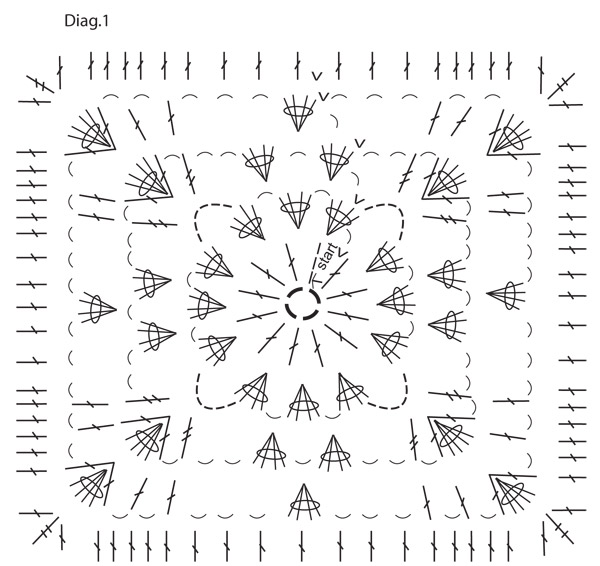
CROCHET SQUARE: See diagram 1 – beg by crocheting 4 ch and grade a ring with one sl st in first ch.
---------------------------------------------------------
---------------------------------------------------------
Coating:
Crochet 20 squares equally described in diagram with crochet hook size four.five mm [The states 7] and 2 threads Alpaca.
ASSEMBLY:
Place squares edge to edge and sew tog, iv squares horizontally and 5 squares vertically. Crochet a edge round the coating equally follows: one dc in each dc and 3 dc in each corner.
Diagram
All measurements in charts are in cm.
 | = sc |
 | = ch |
 | = sl st |
 | = pleat: crochet 4 very loose hdc without pulling thread through (= 9 loops on claw). Brand 1 YO and pull thread through the commencement 8 loops on hook. Make 1 YO and pull thread through the remaining 2 loops on hook. |
 | = dc |
 | = tr |

Do yous demand help with this blueprint?
Thank you for choosing a DROPS Blueprint pattern. We take pride in providing patterns that are correct and easy to understand. All patterns are translated from Norwegian and y'all can always check the original pattern (DROPS Infant 18-xx) for measurements and calculations.
Are you having trouble following the pattern? Run into below for a list of resource to aid you lot finish your projection in no fourth dimension - or why not, learn something new.
Do you have a question?
Encounter a list of oft asked questions (FAQ).
i) Why is the knitting/crochet tension and then important?
Knitting tension is what determines the final measurements of your work, and is commonly measured per 10 ten 10 cm. It is provided like so: number of stitches in width x number of rows in height - eg: nineteen stitches ten 26 rows = ten 10 x cm.
The knitting tension is very individual; some people knit/crochet loosely while others work tightly. Yous adjust the knitting tension with the needle size, which is why the suggested needle size only serve as a guide! You demand to adjust this (upwards or down) to ensure that YOUR knitting tension matches the knitting tension provided in the blueprint. If you work with a different knitting tension than provided you will accept a dissimilar yarn consumption, and your work will take unlike measurements than what the pattern suggests.
The knitting tension besides determines which yarns can replace each other. As long as yous accomplish the same knitting tension you can replace one yarn with another.
See DROPS lesson: How to measure your tension/gauge
See DROPS video: How to brand a approximate tension swatch
to top
2) What are the yarn groups?
All our yarns are categorised into yarn groups (from A to F) according to thickness and knitting tension – group A contains the thinnest yarns and group F the thickest. This makes information technology easier for you to observe culling yarns to our patterns, should you wish to switch yarn. All yarns within the same group have a similar knitting tension and tin can easily supercede each other. However, different yarn qualities accept unlike structures and properties which will requite the finished work a unique look and feel.
Click hither for an overview of the yarns in each yarn grouping
to elevation
3) Can I utilize a different yarn than what the pattern suggests?
The of import matter when changing from one yarn to another is that the knitting/crochet tension remains the aforementioned. This is so that the measurements of the finished piece will exist the same every bit on the sketch provided. It is easier to accomplish the same knitting tension using yarns from the same yarn group. It is also possible to work with multiple strands of a thinner yarn to attain the knitting tension of a thicker i. Delight endeavour our yarn converter. We recommend you to always work a exam swatch.
Delight NOTE: when irresolute yarn the garment might accept a different expect and experience to the garment in the photograph, due to individual properties and qualities of each yarn.
See DROPS lesson: Can I employ a different yarn than the 1 mentioned in the design?
to top
4) How do I use the yarn converter?
At the superlative of all our patterns y'all'll find a link to our yarn converter, which is a helpful tool should you wish to employ a different yarn than suggested. By filling in the yarn quality you wish to replace, the corporeality (in your size) and number of strands, the converter volition nowadays good culling yarns with the same knitting tension. Additionally it will tell you how much yous'll require in the new qualities and whether yous'll demand to work with multiple strands. Most skeins are 50g (some are 25g or 100g).
If the design is worked with multiple colours, every colour will have to be converted separately. Similarly, if the pattern is worked with several strands of different yarns (for example i strand Alpaca and i strand Kid-Silk) you will have to find alternatives for each, individually.
Click here to see our yarn converter
to summit
5) Why practice I get the incorrect knitting tension with the suggested needle size?
The needle size provided in the design serves merely as a guide, the important thing is to follow the knitting tension. And since knitting tension is very individual, you volition have to adjust the needle size to ensure that YOUR tension is the aforementioned equally in the pattern – maybe you lot'll have to adjust i, or fifty-fifty 2 needle sizes, up or downward to accomplish the correct tension. For this, we recommend that you work test swatches.
Should you lot work with a unlike knitting tension than the ane provided, the measurements of the finished garment might deviate from the measurement sketch.
See DROPS lesson: How to measure your tension/judge
See DROPS video: How to make a estimate tension swatch
to top
6) Why is the pattern worked summit-downwardly?
Working a garment top-downwards provides more flexibility and room for personal adjustment. For example it is easier to attempt the garment on while working, as well every bit making adjustments to length of yoke and shoulder caps.
The instructions are carefully explaining every step, in the correct gild. Diagrams are adapted to the knitting direction and are worked as usual.
to tiptop
7) Why are the sleeves shorter in larger sizes?
The total width of the garment (from wrist-to-wrist) volition be larger in the larger sizes, despite the actual sleeves existence shorter. The larger sizes accept longer sleeve caps and wider shoulders, so there will be a good fit in all sizes.
to acme
8) What is a repeat?
Diagrams are often repeated on the round or in height. i echo is the diagram the style it appears in the pattern. If it says to work 5 repeats of A.1 in the round, then you work A.1 a total of v times after/next to each other in the round. If it says to work 2 repeats of A.ane vertically/in height you lot piece of work the unabridged diagram one time, then begin over again at the start and work the entire diagram 1 more fourth dimension.
to top
nine) How do I piece of work according to a knitting diagram?
The diagram depicts all rows/rounds, and every stitch seen from the right side. It is read from bottom to pinnacle, from right to left. one square = i run up.
When working dorsum and along, every other row is worked from the correct side and every other row is worked from the incorrect side. When working from the incorrect side, the diagram will have to be worked reversed: from left to correct, knit stitches are purled, purl stitches are knit etc.
When working in the round every round is worked from the right side and the diagram are worked from right to left on all rounds.
See DROPS lesson: How to read knitting diagrams
to height
10) How do I work according to a crochet diagram?
The diagram depicts all rows/rounds, and every stitch seen from the right side. It is worked from bottom to top, from right to left.
When working dorsum and forth every other row is worked from the right side: from correct to left and every other row is worked from the wrong side: from left to right.
When working in the round, every row in the diagram are worked from the correct side, from correct to left.
When working a circular diagram y'all starting time in the middle and work your way outwards, counter clockwise, row by row.
The rows usually start with a given number of chain stitches (equivalent to the height of the following run up), this volition either exist depicted in the diagram or explained in the blueprint.
See DROPS lesson: How to read crochet diagrams
to top
11) How practice I work several diagrams simultaneously on the same row/round?
Instructions for working several diagrams after each other on the same row/round, will ofttimes be written like then: "work A.ane, A.2, A.3 a total of 0-0-two-3-4 times". This means you lot piece of work A.one in one case, so A.2 is worked once, and A.3 is repeated (in width) the number of times provided for your size – in this case similar and then: S = 0 times, M = 0 times, L=2 times, XL= iii times and XXL = 4 times.
The diagrams are worked as usual: brainstorm with the beginning row in A.1, then work the commencement row in A.2 etc.
Meet DROPS lesson: How to read knitting diagrams
See DROPS lesson: How to read crochet diagrams
to top
12) Why does the slice beginning with more chain stitches than it's worked with?
Chain stitches are slightly narrower than other stitches and to avert working the cast-on edge too tight, we simply concatenation more stitches to begin with. The stitch count volition be adapted on the post-obit row to fit the pattern and measurement sketch.
to elevation
13) Why increase before the rib edge when the piece is worked top-down?
The rib border is more than elastic and will contract slightly compared to, for instance, stocking stitch. By increasing before the rib border, you avoid a visible deviation in width between the rib edge and the residue of the body.
to top
14) Why increase in the bandage-off edge?
It's very like shooting fish in a barrel to bandage off too tightly, and by making yarn overs while casting off (and simultaneously casting these off) you avoid a too tight bandage off edge.
Encounter DROPS video: How to bind off with yarn overs (yo)
to elevation
15) How do I increase/subtract on every 3rd and 4th row/round alternately?
To achieve an fifty-fifty increase (or decrease) you tin can increase on, for case: every 3rd and 4th row alternately, similar and then: work two rows and increment on the 3rd row, work 3 rows and increase on the 4th. Repeat this until the increase is consummate.
See DROPS lesson: Increase or subtract 1 st on every 3rd and 4th row alternately
to top
16) Why is the pattern slightly different than what I run across in the photo?
Blueprint repeats can vary slightly in the different sizes, in social club to get the correct proportions. If y'all're non working the exact same size as the garment in the photo, yours might deviate slightly. This has been advisedly developed and adjusted so that the complete impression of the garment is the aforementioned in all sizes.
Brand sure to follow instructions and diagrams for your size!
to top
17) How can I work a jacket in the round instead of dorsum and forth?
Should you adopt to work in the circular instead of back and along, y'all may of course adapt the blueprint. You lot'll need to add steeks mid-front (usually five stitches), and follow the instructions. When you lot would normally turn and work from the incorrect side, just work across the steek and proceed in the round. At the end you'll cut the piece open up, pick up stitches to work bands, and cover the cutting edges.
Encounter DROPS video: How to knit steeks and cutting open up
to top
18) Tin I work a jumper dorsum and forth instead of in the circular?
Should you prefer to piece of work dorsum and along instead of in the round, you lot may of class adjust the design so you work the pieces separately so gather them at the end. Split the stitches for the torso in 2, add 1 edge stitch in each side (for sewing) and piece of work the front and back pieces separately.
See DROPS lesson: Can I adjust a pattern for circular needles into straight needles?
to meridian
19) Why do you show discontinued yarns in the patterns?
Since unlike yarns have different qualities and textures nosotros have chosen to keep the original yarn in our patterns. However, you lot can easily observe options amidst our available qualities by using our yarn converter, or simply option a yarn from the same yarn group.
It is possible that some retailers nevertheless have discontinued yarns in stock, or that someone has a few skeins at domicile that they would similar to observe patterns for.
The yarn converter will provide both alternative yarn besides as required corporeality in the new quality.
to meridian
20) How do I make a women's size garment into a men's size one?
If you have plant a pattern you like which is available in women's size it's not very difficult to convert it to men's size. The biggest difference volition exist the length of sleeves and torso. Kickoff working on the women size that you think would fit across the breast. The additional length will be worked correct before you cast off for the armhole/sleeve cap. If the pattern is worked top-downward you can add together the length correct subsequently the armhole or before the outset subtract on sleeve.
Regarding additional yarn amount, this volition depend on how much length you add, but it is better with a skein likewise many than too few.
to top
21) How do I prevent a hairy garment from shedding?
All yarns volition accept backlog fibres (from product) that might come up off as lint or shedding. Brushed yarns (ie hairier yarns) have more of these loose, excess fibres, causing more shedding.
Shedding too depends on what is worn under or over the garment, and whether this pulls at the yarn fibres. It'southward therefore non possible to guarantee that there will be no shedding
Below are some tips on how to get the best result when working with hairier yarns:
1. When the garment is finished (before yous wash it) shake it vigorously so the looser hairs come off. NOTE: exercise Non employ a lint roller, brush or any method that pulls at the yarn.
2. Identify the garment in a plastic handbag and put it in your freezer - the temperature volition crusade the fibres to become less fastened to each other, and excess fibres will come off easier.
iii. Leave in the freezer for a few hours earlier taking it out and shaking it once again.
iv. Wash the garment according to the instructions on the yarn label.
to elevation
22) Where on the garment is the length measured?
The measurement sketch/schematic drawing provides information regarding the full length of the garment. If it's a jumper or a jacket the length is measured from the highest signal on the shoulder (normally closest to the neckline), and straight downwards to the bottom of the garment. Information technology is NOT measured from the tip of shoulder. Similarly, the length of yoke is measured from the highest point on the shoulder and down to where yoke is carve up into body and sleeves.
Run across DROPS lesson: How to read a schematic drawing
to acme
23) How exercise I know how many assurance of yarn I demand?
The required amount of yarn is provided in grams, eg: 450 g. To summate how many balls you lot'll need y'all first need to know how many grams are in one ball (25g, 50g or 100g). This information is available if you click on the private yarn quality on our pages. Divide the amount required with the amount of each ball. For instance, if each ball is 50g (the most common amount), the calculation will be as follows: 450 / 50 = 9 balls.
to top
Have y'all purchased DROPS yarn to make this pattern? Then y'all are entitled to receive assist from the store where you bought the yarn.
Observe a listing of DROPS stores here!Still can't find the answer y'all need? Then ringlet down and exit your question so one of our experts can try to assistance yous. This volition be done normally within five to 10 working days. In the meantime, you can read the questions and answers that others have left to this pattern or
join the DROPS Workshop on Facebookto go help from fellow knitters/crocheters!
Comments / Questions (29)
Mail service a comment to blueprint DROPS Baby 18-xx
We would dear to hear what y'all have to say about this pattern!
If you want to get out a question, please make sure you select the right category in the form below, to speed upward the answering process. Required fields are marked *.
© 1982-2022 DROPS Pattern A/South We reserve all rights. This certificate, including all its sub-sections, has copyrights.
What can yous do with our patterns? Yous can
, using the pattern original picture, materials, proper name and number. But y'all are Not Immune to reproduce the consummate pattern digitally in any way.
Yarn storesare welcome to use the DROPS design database to promote the sale of our assortment. You tin can impress out our patterns, make every bit many copies as yous'd like. The only matter we ask is that you don't make any changes / additions to the original printed document. And that the patterns according to the DROPS philosophy are given out to the consumers for free.
Editorialsthat wish to publish our patterns in printed books or magazines tin contact us for more information. The
sale of garmentsbased on DROPS patterns is permitted equally long equally they are sold every bit single items or per club. Further commercial use of the patterns is not permitted. It has to exist clearly stated that the garment is made based on a blueprint from DROPS DESIGN. The use of clothing labels of which DROPS Design forms part is conditioned by the inclusion of the following text: "A DROPS DESIGN fabricated by …..". The
use of DROPS photosfor marketing purposes/sales is just permitted in connexion with the apply/sale of DROPS products. The photos may non be cut or edited and the
logo should be conspicuously visible.
Nosotros reserve the right to withdraw the permission for employ of our patterns at whatsoever time, notwithstanding the reason.
Source: https://www.garnstudio.com/pattern.php?id=3884&cid=17
0 Response to "Free Crochet Pattern 18" X 20" Baby Blanket"
Post a Comment